Client Report Studio
Kundli software for professional astrologers
Compose a complete, client-ready Vedic calculation dossier in your browser: one birth entry, the divisional charts, three-level Vimshottari, Ashtakavarga, Shadbala components, Jaimini karakas and a limited annual module - carrying your practice's name, printed to A4.
100% private - the dossier is composed entirely in your browser. No client birth data sent anywhere.
Licence and activationRs 2,499 - one-time, tax-inclusiveOne practitioner, two browser installations, key with no expiry date. 7-day refund.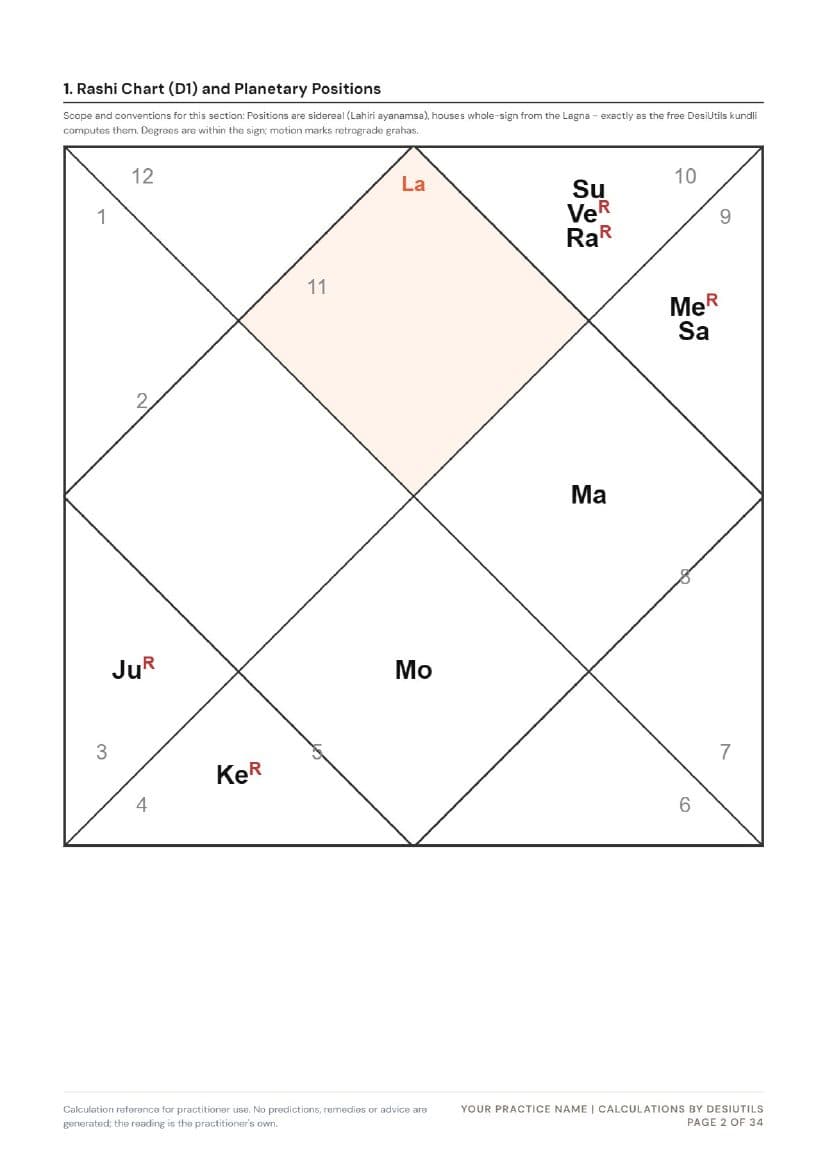
What the Studio does
- Runs in your browser. No installation, no dongle.
- Client confidentiality by construction: names, birth details, charts and logos are processed on your device and never uploaded to us.
- One input, every section: D1 plus all divisional charts currently available in DesiUtils (D2, D3, D4, D7, D9, D10, D12, D16, D20, D24, D30), Vimshottari to Pratyantardasha, Ashtakavarga BAV and SAV, Shadbala components, birth panchang elements, Chara Karakas and Karakamsha, and a Varsha Pravesh annual module.
- Co-branded for your practice: your name, logo and contact on the dossier, with one provenance line - Calculations by DesiUtils.
- Every table shows its ruleset, convention and limitations. Sources shown, not asserted.
- Calculation only, by design: no generated predictions, remedies or interpretation. The reading is yours.
Inside the dossier
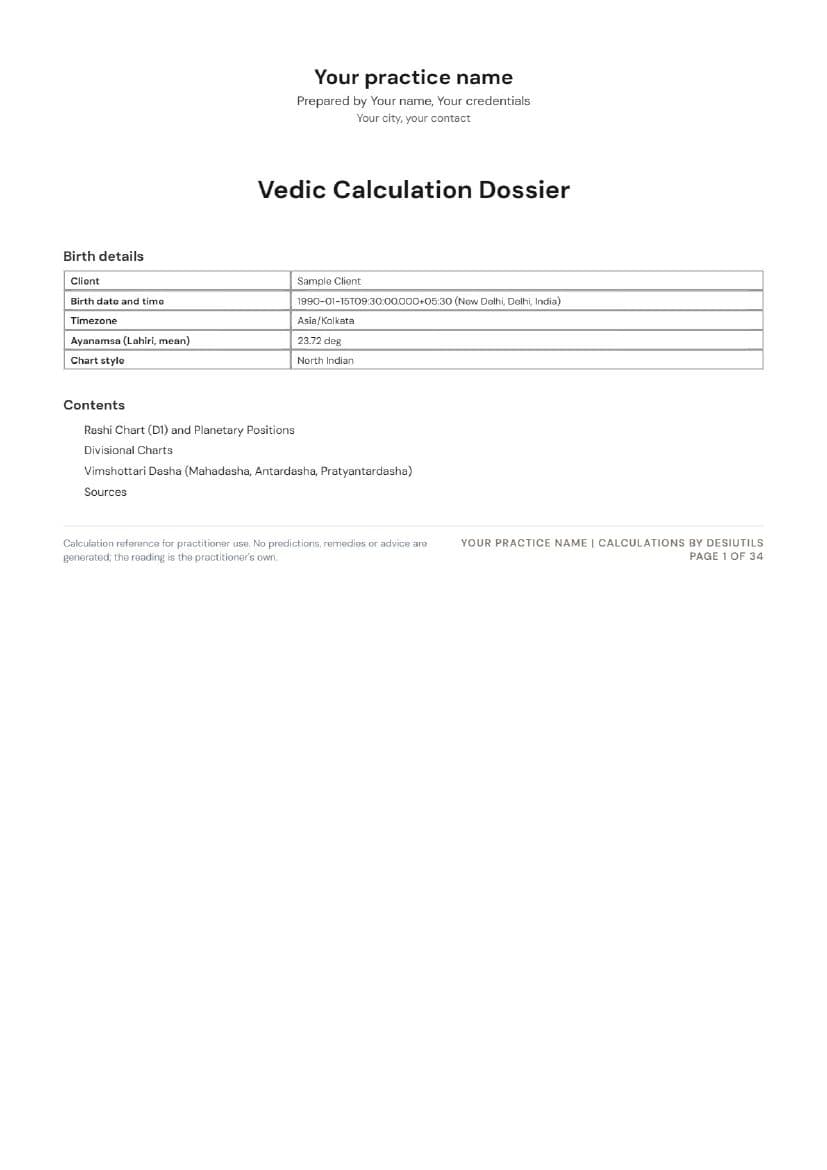
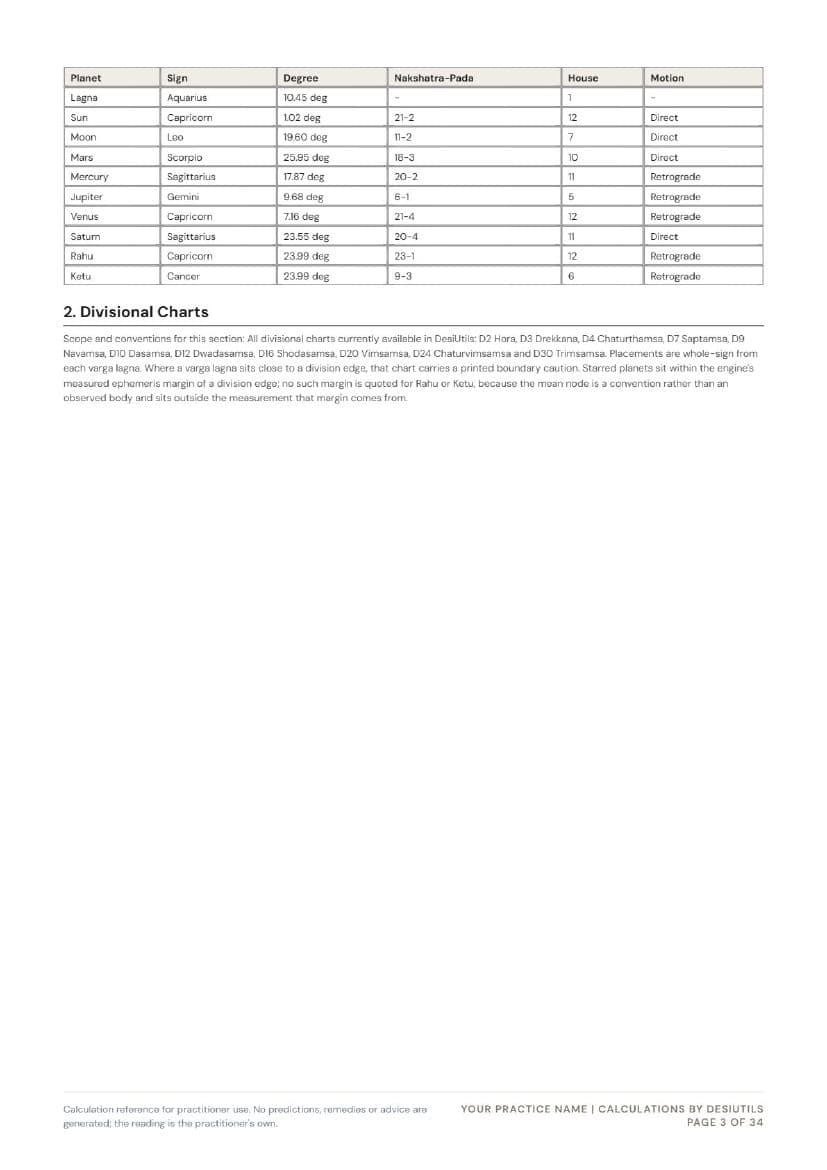
Pages from a dossier this tool exported, at A4.
Quick Facts
| Price | Rs 2,499 one-time, tax-inclusive |
|---|---|
| Licence scope | One practitioner |
| Installations | 2 browser installations, key with no expiry date |
| Refund window | 7 days |
| Output | On-screen dossier view and A4 PDF, composed from one birth entry |
| Divisional charts | D1 plus D2, D3, D4, D7, D9, D10, D12, D16, D20, D24 and D30 |
| Also included | Vimshottari to Pratyantardasha, Ashtakavarga BAV and SAV, Shadbala components, birth panchang elements, Chara Karakas and Karakamsha |
| Optional module | Varsha Pravesh annual chart for a chosen year |
| Co-branding | Your practice name, logo and contact, with one provenance line - Calculations by DesiUtils |
| Client data | Processed on your device and never uploaded to us |
What is free, and what the Studio adds
Free tools
Free, and staying free: every DesiUtils astrology tool, each with its own results on screen and free PDF export, one tool at a time, DesiUtils-branded.
Client Report Studio
Client Report Studio adds: one input instead of re-entering data per tool; a single composed dossier to review on screen and export as a fixed A4 PDF; selectable sections; your practice's branding on the dossier; and a professional license to deliver dossiers to your paying clients.
The free tools are not reduced or moved behind this license in any way.
Licence and activation
Preparing a clean workspace...
Sources
Where the calculations in this dossier come from, and what each source is used FOR - the rule followed, the maths computed, the software that evaluates it, or the baseline it was checked against. Cited so the reading can be checked, not to endorse any interpretation.
Across the whole dossier
- Jean Meeus, Astronomical Algorithms, 2nd ed. (1998)Calculation source
Positional astronomy throughout: the ascendant (ch. 26), the Moon (ch. 47), light-time iteration (ch. 33), the Moon's mean node (formula 47.7) and the sunrise algorithm behind the birth panchang (ch. 15).
Whole dossier
- VSOP87 planetary theory (Bretagnon and Francou, 1988)Calculation source
The heliocentric planetary series every chart here is built from - the VSOP87B sets for Mercury through Saturn, plus Earth.
Whole dossier
- astronomia (MIT-licensed JavaScript library, Meeus-based)Implementation
Evaluates Meeus and VSOP87 in your browser, and supplies the delta-T model used to reach the ephemeris time scale. It is HOW the theory is computed here, not an authority for any rule in it.
Whole dossier
- Lahiri (Chitrapaksha) ayanamsa - Rashtriya Panchang, Calendar Reform Committee (1956)Convention followed
The sidereal reference for every chart here, applied as mean ayanamsa plus nutation in longitude.
Whole dossier
- Swiss Ephemeris 2.10.03 (Lahiri)Validation baseline
Nothing here is computed from it. The SEVEN CLASSICAL PLANETS' sidereal longitudes were audited against it over 1,176 sampled epochs per body, 1900-2031, and that audit is the whole basis of the 0.01 deg boundary caution printed against those bodies. It does not cover the mean node, the ascendant, dates from 2032 onward, or any other margin this dossier prints - the Ashtakavarga, Jaimini and annual cautions are derived separately and cite their own baselines below.
Whole dossier
Per section
- JPL Horizons (DE441) - retrograde station parity capture (26 July 2026)Validation baseline
Direction of motion only; no longitude here is taken from it. Mercury, Venus, Mars, Jupiter and Saturn were compared against Horizons' apparent geocentric longitude on 1,205 interior daily comparisons - 241 days for each of the five planets. Ephemerides were requested for 1 Nov 1989 to 1 Jul 1990; the two endpoint days are what the centred calculation reads either side and are not themselves comparison rows. The shipped central-difference flag disagreed on none of the 1,205. It does not cover the Sun or Moon, which never retrograde, nor Rahu and Ketu, whose motion is printed by CONVENTION rather than measured.
Rashi Chart (D1) and Planetary Positions; Divisional Charts
- JPL Horizons (DE441) - Sun and Moon longitude checkValidation baseline
The Sun and Moon apparent longitudes the panchang angas are cut from agree with Horizons to under 1 arcsecond across 649 five-minute grid instants, the covering window 7 Aug 00:00 to 9 Aug 06:00 IST for the two civil days 7-8 August 2026. A separate check from the station sweep above, on different bodies and a different quantity, and its scope is those two days - not a general claim about panchang accuracy at any date.
Birth Panchang Elements
- Brihat Parashara Hora Shastra (Santhanam translation, 1984)Convention followed
Whole-sign houses, the divisional-chart construction rules, the Vimshottari dasha scheme, and the sunrise-bounded Vedic day and weekday framing behind the birth panchang elements. The Karakamsha is read from the D9 built by these same rules.
Rashi Chart (D1) and Planetary Positions; Divisional Charts; Vimshottari Dasha (Mahadasha, Antardasha, Pratyantardasha); Birth Panchang Elements; Jaimini Chara Karakas and Karakamsha
- Patel and Aiyar (1957), with B.V. Raman, Hindu Predictive AstrologyConvention followed
The adopted Ashtakavarga benefic places, supported by Brihat Jataka and Saravali. Where the BPHS Sharma/Santhanam recension disagrees on one benefic place, this dossier follows the adopted reading and prints the conflict rather than choosing silently.
Ashtakavarga (Bhinnashtakavarga and Sarvashtakavarga)
- Parashara, Brihat Parashara Hora Shastra, Ch. 26-27 (Santhanam-lineage transcription, accessed 3 August 2026)Convention followed
The six-fold Shadbala STRUCTURE and the construction of each component, verse-anchored to that transcription rather than to a stated print edition. Where the verses are silent, five arithmetic conventions were selected against the reference implementation and are named on the free Shadbala page. Component values only; no total, ratio or ranking is computed.
Shadbala Components
- B.V. Raman, Graha and Bhava Balas, 13th ed., ch. VI arts. 86-107 (consulted 1 August 2026)Calculation source
CHESHTA BALA ALONE: the printed Sripathi formula with the Kedarnath Dutt mean tables (epoch 1900, Ujjain mean midnight), which are set out at arts. 88-91. This is the one Shadbala component whose lineage rests on a printed source with a stated edition; it is not the source of the other five.
Shadbala Components
- Jagannatha Hora (JHora)Validation baseline
A cross-check, never an authority. Selected Shadbala component conventions were checked against it where the classical text underdetermines a construction, and the chara-karaka ranking and the navamsa sign mapping are each pinned against it.
Shadbala Components; Jaimini Chara Karakas and Karakamsha
- P.V.R. Narasimha Rao, Lessons on Vedic Astrology, Vol. II (vedicastrologer.org, consulted July 2026)Convention followed
The eight-karaka scheme this dossier computes - Rahu included with its degree reversed, Ketu excluded - and the graha-drishti convention behind the D9 aspect list. The seven-karaka Neelakantha/K.N. Rao alternative is offered on the free surfaces and is NOT the scheme used here.
Jaimini Chara Karakas and Karakamsha
- Sanjay Rath, "Atmakaraka and Karakamsa" (srath.com, accessed 1 July 2026)Convention followed
The working Karakamsha definition computed here: the navamsa sign the Atmakaraka occupies. His note that the Atmakaraka can also be examined in other divisional charts is why the D9 is the default school rather than the only one.
Jaimini Chara Karakas and Karakamsha
- B.V. Raman, Varshaphal or The Hindu Progressed Horoscope, with K.S. Charak, A Textbook of VarshaphalaConvention followed
The solar-return definition, the birthplace convention (birth coordinates, not current residence), the Muntha, and the count-based Mudda dasha. Consulted through digital scans, not verified against a stated print edition. This dossier uses the nine-full-period Mudda; Charak's natal-Moon-balance variant was tested and not adopted.
Annual Chart (Varsha Pravesh, Muntha, Mudda Dasha)
- Tajika Neelakanthi tradition, as summarised at vedastro.org (accessed 19 July 2026)Convention followed
The Muntha rule and its favourable-house set. The popular per-house predictions that circulate alongside it vary between sources and are deliberately not reproduced.
Annual Chart (Varsha Pravesh, Muntha, Mudda Dasha)
- AstroSage annual-horoscope parity capture (accessed 20 July 2026)Validation baseline
On the 15 Aug 1990, 10:30, Jamnagar fixture the solar-return moment agreed within about 3.3 minutes, the Varsha Lagna matched, and the nine-row Mudda dasha matched in exact lord sequence with every period start within two days.
Annual Chart (Varsha Pravesh, Muntha, Mudda Dasha)
- Recorded live panchang capture, Delhi, 7-8 August 2026Validation baseline
Anga names, sequences and boundary times are pinned against retained captures in the automated regression suite, with the display-rounding convention stated rather than tuned to any one almanac.
Birth Panchang Elements
Frequently Asked Questions
What is Client Report Studio?
A browser-based kundli software for professional astrologers. One birth entry composes a client-ready calculation dossier - the D1 chart, all divisional charts currently available in DesiUtils (D2, D3, D4, D7, D9, D10, D12, D16, D20, D24, D30), Vimshottari dasha to Pratyantardasha, Ashtakavarga BAV and SAV, Shadbala components, birth panchang elements, Jaimini Chara Karakas with Karakamsha, and an optional Varsha Pravesh annual module - printed to A4 with your practice's name on it.
Does it write predictions or interpretations for my clients?
No, by design. The Studio computes and presents; it generates no predictions, no remedies and no interpretive text. The reading is yours - that is the product's whole premise for practitioners, and every table carries its ruleset, conventions and limitations so you can stand behind the numbers.
Is my client's birth data uploaded anywhere?
No. Client names, birth details, chart results, logos and dossier contents are processed in your browser and never uploaded to us. License checks send only your license key, a random identifier for the browser installation, and timestamps - they are separate from, and never joined to, anything you enter into the Studio.
How does the license work?
One practitioner, one-time Rs 2,499 (tax-inclusive), with up to two browser installations active at a time. Your license key is the payment ID on your receipt; validity is checked online periodically, and you can deactivate an installation from an active one to move to a new browser. There is a 7-day refund; a refund disables the key.
How is this different from the free DesiUtils tools?
Every free tool stays free and unchanged - each computes its own result and exports its own DesiUtils-branded PDF, one tool at a time. The Studio adds what a practice needs on top: one input instead of re-entering data per tool, a single composed dossier with selectable sections, your own name and logo on the output, a fixed A4 page layout, and a professional license to deliver dossiers to paying clients.
Can I put my own branding on the dossiers?
Yes - your practice name, your name, a credentials line, a contact line and a logo appear on the dossier cover, and every page's footer carries your practice name. One provenance line, 'Calculations by DesiUtils', always prints alongside them, so the output is co-branded rather than unbranded.
Which chart styles and languages does it support?
North Indian and South Indian chart styles, selectable per dossier. The current version produces English dossiers; planetary and panchang names use standard transliteration. Your own branding fields render in the script you type them in.
Related Tools
Kundli Generator
Free Janam Kundli with D1 and D9 charts, planetary positions, Vimshottari Dasha, and Mangal Dosha. Lahiri sidereal.
astrologyVimshottari Dasha Calculator
Free Vimshottari Dasha timeline by date of birth. Personalized 9 Mahadashas with every Antardasha from birth, and your current Mahadasha and Antardasha highlighted.
astrologyNavamsa Chart Calculator
Free Navamsa (D9) chart from birth details. Navamsa Lagna with a birth-time-confidence check, per-planet D9 placements, and vargottama detection.
astrology